top of page

Modality Matters in Language Learning
The effects of practice modality on learners' language development.
Role
Duration
Tools
Participants
Lead Researcher & Data Analyst
Fall 2026
LJT, ODCT, R
L2 Chinese learners
LJT Performance Across Modalities
Across testing intervals, the Input group demonstrated the largest gains in recognition accuracy, and a sustained reduction in response times. While the Output group showed moderate accuracy improvement, both treatment groups outperformed the Control group.

ODCT Performance Across Modalities
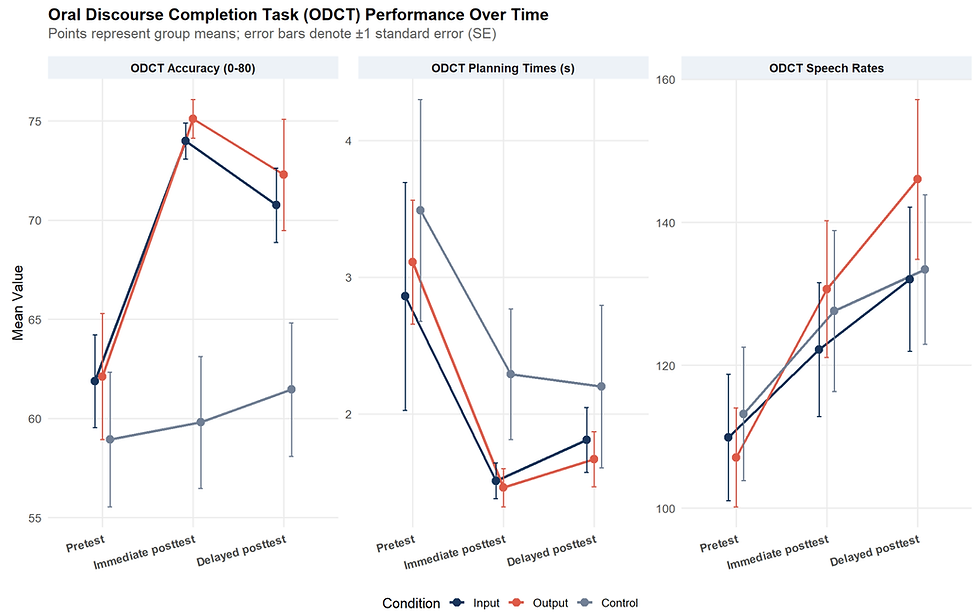
Both the Input and Output groups achieved comparable gains in production accuracy and reductions in planning time. However, the Output group demonstrated a decisive advantage in oral fluency, sustaining superior gains in speech rates through the delayed posttest.
Recognition Accuracy Rates
Across all three conditions, the Input group achieved superior recognition accuracy over time, with the largest divergence occurring in Option B where input-based practice drove substantial, sustained gains while output and control groups remained near or below 50%.

Data Analysis and Discussion Leading
During the process of data analysis, I led the discussion of the test results, encouraging my teammates to express their thoughts and therefore we gathered some valuable insights.

Research Background
The Research Gap in Language Development
For over two decades, Applied Linguistics field obsessed over explicitness but ignored Modality (how learners practice). This is why we isolated modality to understand true language development.

Competence Analysis: Knowledge vs. Processing
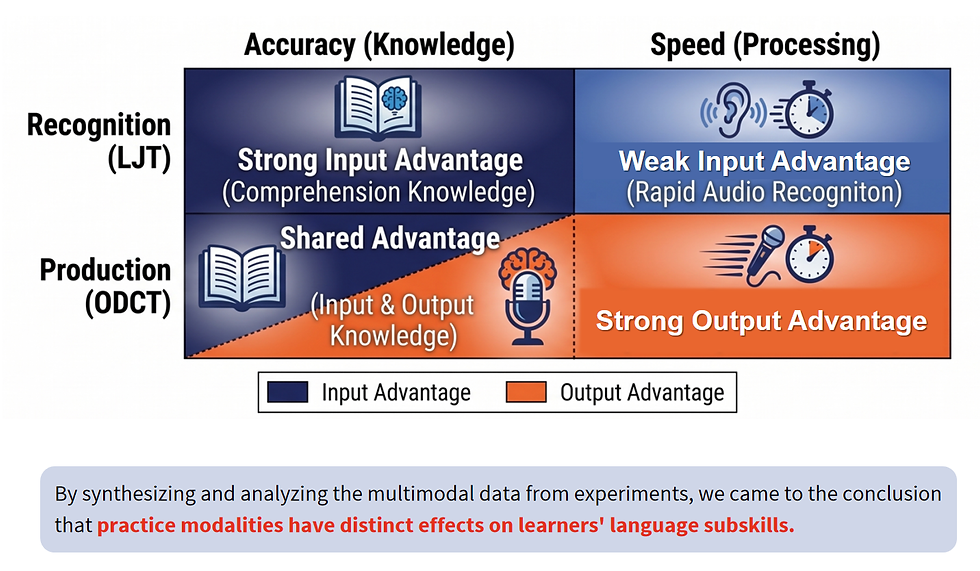
Through synthesizing 20+ research papers and relevant publications, we drew the conclusion: While typical metrics prioritize accuracy, true proficiency requires balancing knowledge mastery with execution efficiency.

Experiment Design
The Study Design and Intervention Timeline
We took a multi-phased timeline to evaluate the interaction of instructional modality and acquisition speed, and isolated specific practice sequences—Input, Output, and Control—measuring their distinct advantages.

Participants and Target Language Forms
A cohort of 48 American study-abroad students completed weekly instruction with no prior exposure to target pragmatics. We taught them four request-making language forms across distinct social contexts.

Input-Based vs. Output-Based Practice
We implemented two instructional designs: Input-Based Practice centered on receptive judgment and comprehension, while Output-Based Practice required sentence translation and dialogue production.

Analysis and Synthesis
Statistical Engine Analysis
To isolate receptive comprehension from expressive delivery, we designed a measurement engine coupled a 32-item Listening Judgment Test with a 22-item Oral Discourse Completion Test.

Why Practice Modality Matters
After comprehensive analysis, we found that input practice encouraged heuristic processing, whereas output practice required exact word-for-word formulation.

Skill Acquisition: Declarative vs. Procedural
We found explicit declarative knowledge readily generalizes across language modalities to boost overall accuracy, while procedural speed requires modality-specific cognitive pathways through targeted, mirrored practice.

Conclusion
Practice Modality Shapes Specific Linguistic Competencies
By synthesizing all the test results, we are confident to draw the conclusion that declarative accuracy transfers broadly across domains, but procedural processing speed improves strictly when practice mirrors testing conditions. Input practice sharpens receptive judgment, whereas output practice uniquely drives oral fluency and speech rates.
Error Detection Relies on Receptive Input Exposure
Through observing the performance of participants, we found that input-based practice proved vital for cultivating fine-grained sensitivity to subtle grammatical inaccuracies (Option B). By repeatedly evaluating contextual exemplars, learners developed robust recognition boundaries that output generation alone failed to produce.
Output Practice Solidifies Long-Term Production Fluency
We also noticed that while both training modes improved immediate grammatical accuracy, output practice triggered "noticing the gap" reflection. This deliberate language assembly led to superior retention and significantly faster, more fluid real-time speech production over time.
bottom of page